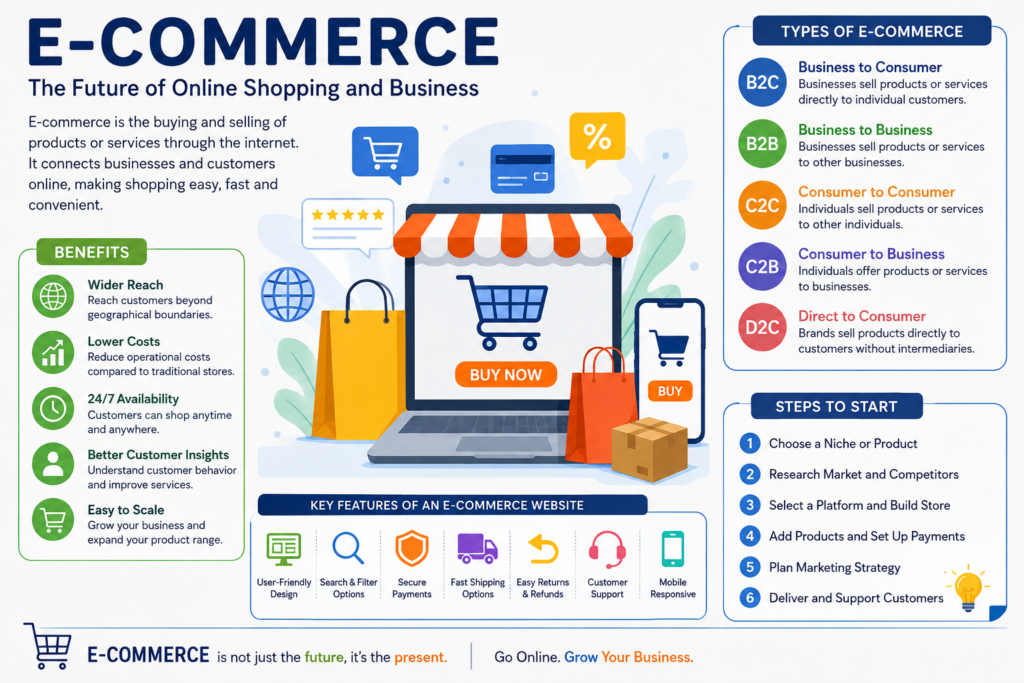

E-commerce Marketing, also known as electronic commerce, refers to the buying and selling of products and services through the internet. It allows businesses to reach customers online without depending only on a physical store. Customers can browse products, compare prices, place orders, and make payments using websites or mobile applications.
Today, e-commerce Marketing has become an important part of the digital economy. From clothing and electronics to groceries and digital services, people can purchase almost anything online. Businesses of all sizes use e-commerce to increase their reach, improve customer convenience, and grow their sales.
With the support of digital marketing strategies such as SEO, social media marketing, email marketing, and paid advertising, e-commerce businesses can attract potential customers and build long-term relationships.
2. What is E-Commerce marketing ?
E-commerce marketing is the process of conducting commercial transactions electronically, mainly through the internet. It includes online shopping, digital payments, online bookings, and the sale of digital products and services.
For example, when a customer purchases a pair of shoes from an online store, the transaction is an example of e-commerce.
An e-commerce marketing website usually includes product pages, product images, prices, shopping carts, checkout options, payment methods, and order tracking features. These elements help customers complete their purchases conveniently.
3. How does E-Commerce marketing Work?
E-commerce marketing follows a series of steps that connect customers with businesses.
Step 1: Product Discovery
Customers discover products through search engines, social media, advertisements, or online marketplaces.
Step 2: Product Selection
Customers visit the website, explore product details, compare prices, and read reviews.
Step 3: Adding Products to the Cart
After selecting a product, customers add it to their shopping cart.
Step 4: Checkout and Payment
Customers provide delivery details and select a payment method, such as UPI, credit card, debit card, or cash on delivery, where available.
Step 5: Order Processing
The seller receives the order, confirms the details, and prepares the product for shipping.
Step 6: Delivery
The product is packed and delivered to the customer’s address.
Step 7: Customer Support
The business provides support for questions, returns, refunds, and product-related issues.
A smooth buying process helps improve customer satisfaction and encourages repeat purchases.
4. Types of E-Commerce Business Models
E-commerce can be divided into several business models based on the parties involved.
4.1 Business-to-Consumer (B2C)
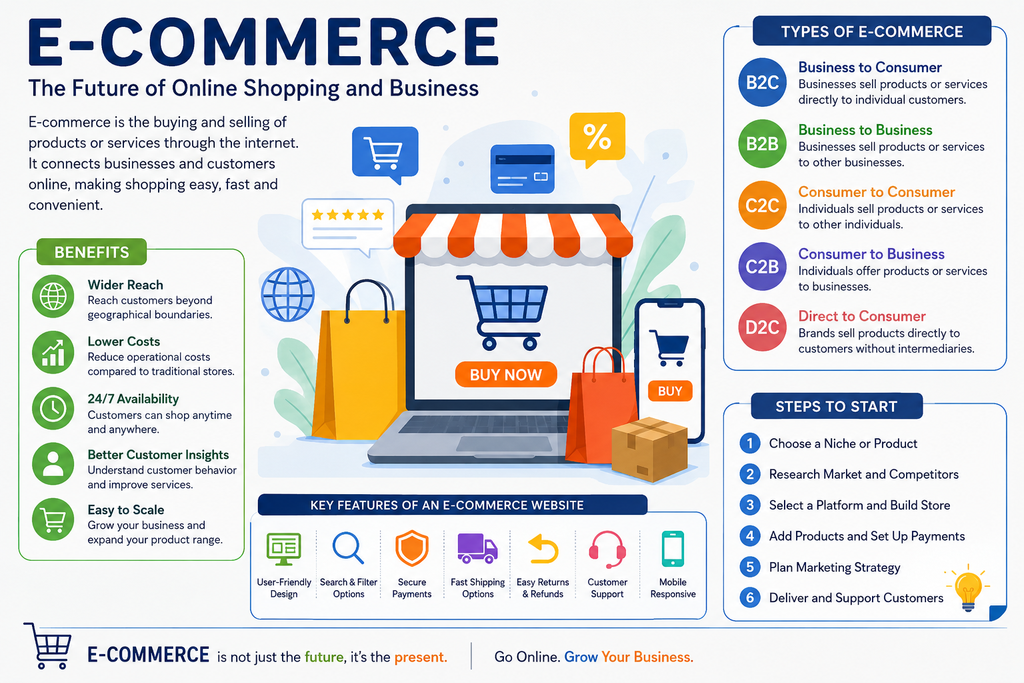
B2C e-commerce occurs when a business sells products or services directly to individual customers.
Example: An online clothing store selling kurtis to customers.
4.2 Business-to-Business (B2B)
B2B e-commerce involves transactions between two businesses.
Example: A wholesaler selling clothing in bulk to a retail store.
4.3 Consumer-to-Consumer (C2C)
C2C e-commerce allows individuals to sell products or services to other individuals through an online platform.
Example: A person selling a used mobile phone through an online resale marketplace.
4.4 Consumer-to-Business (C2B)
C2B occurs when individuals provide products or services to businesses.
Example: A freelance graphic designer creating advertisements for a company.
4.5 Direct-to-Consumer (D2C)
D2C businesses sell their products directly to customers without relying entirely on traditional retailers.
Example: A skincare brand selling products through its own website.
5. Major Types of E-Commerce Platforms
Businesses can choose different platforms depending on their needs, budget, and technical skills.
5.1 E-Commerce Websites
A business can create its own website to showcase products, accept orders, and manage customers.
5.2 Online Marketplaces
Marketplaces allow multiple sellers to list products on a shared platform. They may provide product discovery, payment systems, and other selling tools.
5.3 Social Commerce
Social commerce involves selling products through social media platforms and shopping features. Businesses can use product posts, reels, advertisements, and direct messages to attract buyers.
5.4 Mobile Commerce
Mobile commerce, also called m-commerce, refers to purchasing products or services through smartphones and mobile applications.
6. Benefits of E-Commerce marketing for Businesses
E-commerce marketing offers several advantages to businesses.
Wider Customer Reach
Online stores can attract customers beyond their local geographical area.
Lower Operating Costs
Depending on the business model, online selling may reduce expenses associated with maintaining a traditional retail store.
24/7 Shopping Convenience
Customers can browse products and place orders at any time.
Better Customer Insights
Analytics tools help businesses understand customer behaviour, popular products, traffic sources, and sales performance.
Easy Product Promotion
Businesses can promote their products through SEO, Google Ads, Meta Ads, influencer marketing, and email campaigns.
Business Scalability
Online businesses can expand their product range, marketing activities, and delivery areas as they grow.
7. Benefits of E-Commerce marketing for Customers
E-commerce also makes shopping more convenient for customers.
- Customers can shop from home.
- Products and prices can be compared easily.
- A wide variety of products is available online.
- Product reviews help customers make informed decisions.
- Multiple payment options may be available.
- Orders can often be tracked online.
- Products can be discovered through personalised recommendations.
However, customers should check product descriptions, seller credibility, return policies, and payment security before purchasing.
8. Challenges of E-Commerce marketing
Although e-commerce provides many opportunities, businesses also face certain challenges.
High Competition
Many businesses sell similar products online, making it difficult to stand out.
Customer Trust
Customers may hesitate to purchase from unfamiliar websites. Clear contact details, secure payments, genuine reviews, and transparent policies can help build trust.
Delivery and Logistics
Delayed deliveries, damaged products, and shipping costs can affect customer satisfaction.
Website Security
Businesses must protect customer information and use secure payment processes.
Cart Abandonment
Customers sometimes add products to their carts but leave without completing their purchases.
Product Returns and Refunds
Businesses need clear policies and an effective process for managing returns, exchanges, and refunds.
9. Role of Digital Marketing in E-Commerce marketing
Digital marketing plays an important role in attracting customers and increasing online sales. Even a well-designed e-commerce website may struggle to generate sales without effective promotion.
9.1 Search Engine Optimization (SEO)
SEO helps e-commerce websites improve their visibility in organic search results. Product pages, category pages, useful content, relevant keywords, and technical improvements can support search performance.
9.2 Social Media Marketing
Platforms such as Instagram, Facebook, and Pinterest can help businesses showcase products, engage with customers, and build brand awareness.
9.3 Google Ads
Google Ads allows businesses to reach people searching for relevant products and services. Search campaigns and Shopping ads, where eligible, can help attract potential buyers.
9.4 Meta Ads
Meta Ads can help businesses promote products to relevant audiences across Facebook and Instagram. Campaign objectives may include sales, traffic, and awareness.
9.5 Email Marketing
Email marketing helps businesses share offers, announce new products, send order-related updates, and encourage repeat purchases with appropriate customer consent.
9.6 Content Marketing
Blogs, buying guides, product comparisons, and helpful videos can educate customers and support their purchase decisions.
Combining these strategies can help e-commerce businesses attract visitors, convert potential customers, and improve customer retention.
10. Essential Features of an E-Commerce marketing Website
An effective e-commerce marketing website should provide a convenient and trustworthy shopping experience.
Important features include:
- Simple navigation and clear categories.
- High-quality product images.
- Accurate product descriptions.
- Transparent pricing and shipping charges.
- Mobile-friendly website design.
- Shopping cart and easy checkout.
- Secure payment options.
- Customer reviews and ratings.
- Clear shipping, return, and refund policies.
- Order confirmation and tracking.
- Accessible customer support.
- Website analytics and performance monitoring.
These features can reduce confusion and make it easier for customers to complete purchases.
11. Steps to Start an E-Commerce Business
Starting an e-commerce business requires planning and consistent execution.
Step 1: Choose a Product or Niche
Identify products that match customer needs, your interests, and your business budget.
Step 2: Research the Market
Study competitors, customer preferences, pricing, demand, and potential profit margins.
Step 3: Select a Business Model
Decide whether to sell your own products, resell products, use a marketplace, or operate a D2C brand.
Step 4: Choose a Selling Platform
You can build your own website or begin selling through an appropriate online marketplace.
Step 5: Create Product Listings
Use clear product titles, informative descriptions, accurate prices, and quality images.
Step 6: Set Up Payments and Delivery
Choose suitable payment methods, shipping partners, and order management processes.
Step 7: Develop a Digital Marketing Strategy
Plan SEO, social media content, paid advertising, and other promotional activities according to your audience and budget.
Step 8: Track Results
Monitor website traffic, conversion rate, customer acquisition cost, sales, and customer feedback.
Step 9: Improve Continuously
Use customer feedback and performance data to improve products, website usability, and marketing campaigns.
12. E-Commerce SEO Best Practices
SEO can help an e-commerce website attract relevant organic traffic.
Keyword Research
Identify the search terms customers use when looking for your products. Include relevant keywords naturally in page titles, headings, descriptions, and useful content.
Product Page Optimization
Write unique product descriptions that explain the features, benefits, sizes, materials, and other relevant details.
Category Page Optimization
Create clear category pages that help users and search engines understand the products available.
Image Optimization
Use descriptive image file names, appropriate image sizes, and meaningful alt text.
Technical SEO
Maintain a mobile-friendly website, improve loading speed, use HTTPS, and fix broken links and indexing problems.
Internal Linking
Link related products, categories, and helpful blog posts where doing so benefits users.
Customer Reviews
Encourage genuine customer feedback and display it appropriately.
SEO results take time and depend on competition, website quality, and many other factors. Rankings and traffic are not guaranteed.
13. Important E-Commerce Metrics to Track
Businesses should monitor key performance indicators (KPIs) to understand their results.
Website Traffic
The number of visits to the website over a selected period.
Conversion Rate
The percentage of website visitors who complete a desired action, such as making a purchase.
Average Order Value (AOV)
The average amount customers spend per order.
Cart Abandonment Rate
The percentage of shopping carts that do not result in completed purchases, based on the measurement method used.
Customer Acquisition Cost (CAC)
The average cost of acquiring a customer.
Return on Ad Spend (ROAS)
The revenue attributed to advertising divided by the advertising spend, using a consistent attribution method.
Customer Retention Rate
The percentage of customers who continue buying from a business over a defined period.
These metrics help businesses identify opportunities to improve profitability and customer experience.
14. Future of E-Commerce
E-commerce continues to develop as technology and customer expectations change.
Mobile shopping, social commerce, artificial intelligence, personalised recommendations, faster fulfilment, and improved payment experiences are influencing online retail.
Businesses are also paying greater attention to customer privacy, sustainable packaging, accessible website design, and transparent business practices.
Companies that understand their customers and adapt responsibly to new technologies may be better positioned to compete in the changing online marketplace.
15. Conclusion
E-commerce has transformed the way businesses sell products and customers shop. It provides opportunities to reach wider audiences, offer convenient shopping experiences, and use digital marketing to grow sales.
However, success requires more than simply creating an online store. Businesses need quality products, a user-friendly website, secure transactions, reliable delivery, customer support, and a well-planned marketing strategy.
By combining e-commerce with SEO, social media marketing, paid advertising, and performance analysis, businesses can build stronger online visibility and long-term customer relationships.
Neha Marketing helps readers understand digital marketing concepts and strategies that can support online business growth.
16. Frequently Asked Questions (FAQs)
What is e-commerce in simple words?
E-commerce means buying and selling products or services through the internet.
What are the four main types of e-commerce?
The four commonly discussed types are B2C, B2B, C2C, and C2B.
What is the difference between e-commerce and traditional commerce?
E-commerce mainly uses online platforms for transactions, while traditional commerce generally involves physical stores or in-person transactions. Many businesses use both.
How does digital marketing help e-commerce businesses?
Digital marketing helps businesses reach potential customers through search engines, social media, online advertising, and email campaigns.
Is SEO important for an e-commerce website?
Yes. SEO can improve organic visibility and help customers discover relevant products through search engines.
Can I start an e-commerce business with a small budget?
It may be possible to start small by selecting a focused product range and an affordable selling platform. Actual costs depend on inventory, delivery, platform fees, and marketing.
How can an e-commerce website increase sales?
A business can improve product pages, simplify checkout, build customer trust, offer reliable delivery, and test suitable marketing campaigns.
What is the difference between e-commerce and m-commerce?
E-commerce includes online commercial transactions across digital devices, while m-commerce specifically refers to transactions made through mobile devices.E-Commerce: A Complete Guide to Online Shopping and Digital Business
1. Introduction to E-Commerce
E-commerce, also known as electronic commerce, refers to the buying and selling of products and services through the internet. It allows businesses to reach customers online without depending only on a physical store. Customers can browse products, compare prices, place orders, and make payments using websites or mobile applications.
Today, e-commerce has become an important part of the digital economy. From clothing and electronics to groceries and digital services, people can purchase almost anything online. Businesses of all sizes use e-commerce to increase their reach, improve customer convenience, and grow their sales.
With the support of digital marketing strategies such as SEO, social media marketing, email marketing, and paid advertising, e-commerce businesses can attract potential customers and build long-term relationships.
2. What Is E-Commerce?
E-commerce is the process of conducting commercial transactions electronically, mainly through the internet. It includes online shopping, digital payments, online bookings, and the sale of digital products and services.
For example, when a customer purchases a pair of shoes from an online store, the transaction is an example of e-commerce.
An e-commerce website usually includes product pages, product images, prices, shopping carts, checkout options, payment methods, and order tracking features. These elements help customers complete their purchases conveniently.
3. How Does E-Commerce Work?
E-commerce follows a series of steps that connect customers with businesses.
Step 1: Product Discovery
Customers discover products through search engines, social media, advertisements, or online marketplaces.
Step 2: Product Selection
Customers visit the website, explore product details, compare prices, and read reviews.
Step 3: Adding Products to the Cart
After selecting a product, customers add it to their shopping cart.
Step 4: Checkout and Payment
Customers provide delivery details and select a payment method, such as UPI, credit card, debit card, or cash on delivery, where available.
Step 5: Order Processing
The seller receives the order, confirms the details, and prepares the product for shipping.
Step 6: Delivery
The product is packed and delivered to the customer’s address.
Step 7: Customer Support
The business provides support for questions, returns, refunds, and product-related issues.
A smooth buying process helps improve customer satisfaction and encourages repeat purchases.
4. Types of E-Commerce Business Models
E-commerce can be divided into several business models based on the parties involved.
4.1 Business-to-Consumer (B2C)
B2C e-commerce occurs when a business sells products or services directly to individual customers.
Example: An online clothing store selling kurtis to customers.
4.2 Business-to-Business (B2B)
B2B e-commerce involves transactions between two businesses.
Example: A wholesaler selling clothing in bulk to a retail store.
4.3 Consumer-to-Consumer (C2C)
C2C e-commerce allows individuals to sell products or services to other individuals through an online platform.
Example: A person selling a used mobile phone through an online resale marketplace.
4.4 Consumer-to-Business (C2B)
C2B occurs when individuals provide products or services to businesses.
Example: A freelance graphic designer creating advertisements for a company.
4.5 Direct-to-Consumer (D2C)
D2C businesses sell their products directly to customers without relying entirely on traditional retailers.
Example: A skincare brand selling products through its own website.
5. Major Types of E-Commerce Platforms
Businesses can choose different platforms depending on their needs, budget, and technical skills.
5.1 E-Commerce Websites
A business can create its own website to showcase products, accept orders, and manage customers.
5.2 Online Marketplaces
Marketplaces allow multiple sellers to list products on a shared platform. They may provide product discovery, payment systems, and other selling tools.
5.3 Social Commerce
Social commerce involves selling products through social media platforms and shopping features. Businesses can use product posts, reels, advertisements, and direct messages to attract buyers.
5.4 Mobile Commerce
Mobile commerce, also called m-commerce, refers to purchasing products or services through smartphones and mobile applications.
6. Benefits of E-Commerce for Businesses
E-commerce offers several advantages to businesses.
Wider Customer Reach
Online stores can attract customers beyond their local geographical area.
Lower Operating Costs
Depending on the business model, online selling may reduce expenses associated with maintaining a traditional retail store.
24/7 Shopping Convenience
Customers can browse products and place orders at any time.
Better Customer Insights
Analytics tools help businesses understand customer behaviour, popular products, traffic sources, and sales performance.
Easy Product Promotion
Businesses can promote their products through SEO, Google Ads, Meta Ads, influencer marketing, and email campaigns.
Business Scalability
Online businesses can expand their product range, marketing activities, and delivery areas as they grow.
7. Benefits of E-Commerce for Customers
E-commerce also makes shopping more convenient for customers.
- Customers can shop from home.
- Products and prices can be compared easily.
- A wide variety of products is available online.
- Product reviews help customers make informed decisions.
- Multiple payment options may be available.
- Orders can often be tracked online.
- Products can be discovered through personalised recommendations.
However, customers should check product descriptions, seller credibility, return policies, and payment security before purchasing.
8. Challenges of E-Commerce
Although e-commerce provides many opportunities, businesses also face certain challenges.
High Competition
Many businesses sell similar products online, making it difficult to stand out.
Customer Trust
Customers may hesitate to purchase from unfamiliar websites. Clear contact details, secure payments, genuine reviews, and transparent policies can help build trust.
Delivery and Logistics
Delayed deliveries, damaged products, and shipping costs can affect customer satisfaction.
Website Security
Businesses must protect customer information and use secure payment processes.
Cart Abandonment
Customers sometimes add products to their carts but leave without completing their purchases.
Product Returns and Refunds
Businesses need clear policies and an effective process for managing returns, exchanges, and refunds.
9. Role of Digital Marketing in E-Commerce
Digital marketing plays an important role in attracting customers and increasing online sales. Even a well-designed e-commerce website may struggle to generate sales without effective promotion.
9.1 Search Engine Optimization (SEO)
SEO helps e-commerce websites improve their visibility in organic search results. Product pages, category pages, useful content, relevant keywords, and technical improvements can support search performance.
9.2 Social Media Marketing
Platforms such as Instagram, Facebook, and Pinterest can help businesses showcase products, engage with customers, and build brand awareness.
9.3 Google Ads
Google Ads allows businesses to reach people searching for relevant products and services. Search campaigns and Shopping ads, where eligible, can help attract potential buyers.
9.4 Meta Ads
Meta Ads can help businesses promote products to relevant audiences across Facebook and Instagram. Campaign objectives may include sales, traffic, and awareness.
9.5 Email Marketing
Email marketing helps businesses share offers, announce new products, send order-related updates, and encourage repeat purchases with appropriate customer consent.
9.6 Content Marketing
Blogs, buying guides, product comparisons, and helpful videos can educate customers and support their purchase decisions.
Combining these strategies can help e-commerce businesses attract visitors, convert potential customers, and improve customer retention.
10. Essential Features of an E-Commerce Website
An effective e-commerce website should provide a convenient and trustworthy shopping experience.
Important features include:
- Simple navigation and clear categories.
- High-quality product images.
- Accurate product descriptions.
- Transparent pricing and shipping charges.
- Mobile-friendly website design.
- Shopping cart and easy checkout.
- Secure payment options.
- Customer reviews and ratings.
- Clear shipping, return, and refund policies.
- Order confirmation and tracking.
- Accessible customer support.
- Website analytics and performance monitoring.
These features can reduce confusion and make it easier for customers to complete purchases.
11. Steps to Start an E-Commerce Business
Starting an e-commerce business requires planning and consistent execution.
Step 1: Choose a Product or Niche
Identify products that match customer needs, your interests, and your business budget.
Step 2: Research the Market
Study competitors, customer preferences, pricing, demand, and potential profit margins.
Step 3: Select a Business Model
Decide whether to sell your own products, resell products, use a marketplace, or operate a D2C brand.
Step 4: Choose a Selling Platform
You can build your own website or begin selling through an appropriate online marketplace.
Step 5: Create Product Listings
Use clear product titles, informative descriptions, accurate prices, and quality images.
Step 6: Set Up Payments and Delivery
Choose suitable payment methods, shipping partners, and order management processes.
Step 7: Develop a Digital Marketing Strategy
Plan SEO, social media content, paid advertising, and other promotional activities according to your audience and budget.
Step 8: Track Results
Monitor website traffic, conversion rate, customer acquisition cost, sales, and customer feedback.
Step 9: Improve Continuously
Use customer feedback and performance data to improve products, website usability, and marketing campaigns.
12. E-Commerce SEO Best Practices
SEO can help an e-commerce website attract relevant organic traffic.
Keyword Research
Identify the search terms customers use when looking for your products. Include relevant keywords naturally in page titles, headings, descriptions, and useful content.
Product Page Optimization
Write unique product descriptions that explain the features, benefits, sizes, materials, and other relevant details.
Category Page Optimization
Create clear category pages that help users and search engines understand the products available.
Image Optimization
Use descriptive image file names, appropriate image sizes, and meaningful alt text.
Technical SEO
Maintain a mobile-friendly website, improve loading speed, use HTTPS, and fix broken links and indexing problems.
Internal Linking
Link related products, categories, and helpful blog posts where doing so benefits users.
Customer Reviews
Encourage genuine customer feedback and display it appropriately.
SEO results take time and depend on competition, website quality, and many other factors. Rankings and traffic are not guaranteed.
13. Important E-Commerce Metrics to Track
Businesses should monitor key performance indicators (KPIs) to understand their results.
Website Traffic
The number of visits to the website over a selected period.
Conversion Rate
The percentage of website visitors who complete a desired action, such as making a purchase.
Average Order Value (AOV)
The average amount customers spend per order.
Cart Abandonment Rate
The percentage of shopping carts that do not result in completed purchases, based on the measurement method used.
Customer Acquisition Cost (CAC)
The average cost of acquiring a customer.
Return on Ad Spend (ROAS)
The revenue attributed to advertising divided by the advertising spend, using a consistent attribution method.
Customer Retention Rate
The percentage of customers who continue buying from a business over a defined period.
These metrics help businesses identify opportunities to improve profitability and customer experience.
14. Future of E-Commerce
E-commerce continues to develop as technology and customer expectations change.
Mobile shopping, social commerce, artificial intelligence, personalised recommendations, faster fulfilment, and improved payment experiences are influencing online retail.
Businesses are also paying greater attention to customer privacy, sustainable packaging, accessible website design, and transparent business practices.
Companies that understand their customers and adapt responsibly to new technologies may be better positioned to compete in the changing online marketplace.
15. Conclusion
E-commerce has transformed the way businesses sell products and customers shop. It provides opportunities to reach wider audiences, offer convenient shopping experiences, and use digital marketing to grow sales.
However, success requires more than simply creating an online store. Businesses need quality products, a user-friendly website, secure transactions, reliable delivery, customer support, and a well-planned marketing strategy.
By combining e-commerce with SEO, social media marketing, paid advertising, and performance analysis, businesses can build stronger online visibility and long-term customer relationships.
Neha Marketing helps readers understand digital marketing concepts and strategies that can support online business growth.
VISIT MY HOME PAGE
16. Frequently Asked Questions (FAQs)
What is e-commerce in simple words?
E-commerce means buying and selling products or services through the internet.
What are the four main types of e-commerce?
The four commonly discussed types are B2C, B2B, C2C, and C2B.
What is the difference between e-commerce and traditional commerce?
E-commerce mainly uses online platforms for transactions, while traditional commerce generally involves physical stores or in-person transactions. Many businesses use both.
How does digital marketing help e-commerce businesses?
Digital marketing helps businesses reach potential customers through search engines, social media, online advertising, and email campaigns.
Is SEO important for an e-commerce website?
Yes. SEO can improve organic visibility and help customers discover relevant products through search engines.
Can I start an e-commerce business with a small budget?
It may be possible to start small by selecting a focused product range and an affordable selling platform. Actual costs depend on inventory, delivery, platform fees, and marketing.
How can an e-commerce website increase sales?
A business can improve product pages, simplify checkout, build customer trust, offer reliable delivery, and test suitable marketing campaigns.
What is the difference between e-commerce and m-commerce?
E-commerce includes online commercial transactions across digital devices, while m-commerce specifically refers to transactions made through mobile devices.E-Commerce: A Complete Guide to Online Shopping and Digital Business
1. Introduction to E-Commerce
E-commerce, also known as electronic commerce, refers to the buying and selling of products and services through the internet. It allows businesses to reach customers online without depending only on a physical store. Customers can browse products, compare prices, place orders, and make payments using websites or mobile applications.
Today, e-commerce has become an important part of the digital economy. From clothing and electronics to groceries and digital services, people can purchase almost anything online. Businesses of all sizes use e-commerce to increase their reach, improve customer convenience, and grow their sales.
With the support of digital marketing strategies such as SEO, social media marketing, email marketing, and paid advertising, e-commerce businesses can attract potential customers and build long-term relationships.
2. What Is E-Commerce?
E-commerce is the process of conducting commercial transactions electronically, mainly through the internet. It includes online shopping, digital payments, online bookings, and the sale of digital products and services.
For example, when a customer purchases a pair of shoes from an online store, the transaction is an example of e-commerce.
An e-commerce website usually includes product pages, product images, prices, shopping carts, checkout options, payment methods, and order tracking features. These elements help customers complete their purchases conveniently.
3. How Does E-Commerce Work?
E-commerce follows a series of steps that connect customers with businesses.
Step 1: Product Discovery
Customers discover products through search engines, social media, advertisements, or online marketplaces.
Step 2: Product Selection
Customers visit the website, explore product details, compare prices, and read reviews.
Step 3: Adding Products to the Cart
After selecting a product, customers add it to their shopping cart.
Step 4: Checkout and Payment
Customers provide delivery details and select a payment method, such as UPI, credit card, debit card, or cash on delivery, where available.
Step 5: Order Processing
The seller receives the order, confirms the details, and prepares the product for shipping.
Step 6: Delivery
The product is packed and delivered to the customer’s address.
Step 7: Customer Support
The business provides support for questions, returns, refunds, and product-related issues.
A smooth buying process helps improve customer satisfaction and encourages repeat purchases.
4. Types of E-Commerce Business Models
E-commerce can be divided into several business models based on the parties involved.
4.1 Business-to-Consumer (B2C)
B2C e-commerce occurs when a business sells products or services directly to individual customers.
Example: An online clothing store selling kurtis to customers.
4.2 Business-to-Business (B2B)
B2B e-commerce involves transactions between two businesses.
Example: A wholesaler selling clothing in bulk to a retail store.
4.3 Consumer-to-Consumer (C2C)
C2C e-commerce allows individuals to sell products or services to other individuals through an online platform.
Example: A person selling a used mobile phone through an online resale marketplace.
4.4 Consumer-to-Business (C2B)
C2B occurs when individuals provide products or services to businesses.
Example: A freelance graphic designer creating advertisements for a company.
4.5 Direct-to-Consumer (D2C)
D2C businesses sell their products directly to customers without relying entirely on traditional retailers.
Example: A skincare brand selling products through its own website.
5. Major Types of E-Commerce Platforms
Businesses can choose different platforms depending on their needs, budget, and technical skills.
5.1 E-Commerce Websites
A business can create its own website to showcase products, accept orders, and manage customers.
5.2 Online Marketplaces
Marketplaces allow multiple sellers to list products on a shared platform. They may provide product discovery, payment systems, and other selling tools.
5.3 Social Commerce
Social commerce involves selling products through social media platforms and shopping features. Businesses can use product posts, reels, advertisements, and direct messages to attract buyers.
5.4 Mobile Commerce
Mobile commerce, also called m-commerce, refers to purchasing products or services through smartphones and mobile applications.
6. Benefits of E-Commerce for Businesses
E-commerce offers several advantages to businesses.
Wider Customer Reach
Online stores can attract customers beyond their local geographical area.
Lower Operating Costs
Depending on the business model, online selling may reduce expenses associated with maintaining a traditional retail store.
24/7 Shopping Convenience
Customers can browse products and place orders at any time.
Better Customer Insights
Analytics tools help businesses understand customer behaviour, popular products, traffic sources, and sales performance.
Easy Product Promotion
Businesses can promote their products through SEO, Google Ads, Meta Ads, influencer marketing, and email campaigns.
Business Scalability
Online businesses can expand their product range, marketing activities, and delivery areas as they grow.
7. Benefits of E-Commerce for Customers
E-commerce also makes shopping more convenient for customers.
- Customers can shop from home.
- Products and prices can be compared easily.
- A wide variety of products is available online.
- Product reviews help customers make informed decisions.
- Multiple payment options may be available.
- Orders can often be tracked online.
- Products can be discovered through personalised recommendations.
However, customers should check product descriptions, seller credibility, return policies, and payment security before purchasing.
8. Challenges of E-Commerce
Although e-commerce provides many opportunities, businesses also face certain challenges.
High Competition
Many businesses sell similar products online, making it difficult to stand out.
Customer Trust
Customers may hesitate to purchase from unfamiliar websites. Clear contact details, secure payments, genuine reviews, and transparent policies can help build trust.
Delivery and Logistics
Delayed deliveries, damaged products, and shipping costs can affect customer satisfaction.
Website Security
Businesses must protect customer information and use secure payment processes.
Cart Abandonment
Customers sometimes add products to their carts but leave without completing their purchases.
Product Returns and Refunds
Businesses need clear policies and an effective process for managing returns, exchanges, and refunds.
9. Role of Digital Marketing in E-Commerce
Digital marketing plays an important role in attracting customers and increasing online sales. Even a well-designed e-commerce website may struggle to generate sales without effective promotion.
9.1 Search Engine Optimization (SEO)
SEO helps e-commerce websites improve their visibility in organic search results. Product pages, category pages, useful content, relevant keywords, and technical improvements can support search performance.
9.2 Social Media Marketing
Platforms such as Instagram, Facebook, and Pinterest can help businesses showcase products, engage with customers, and build brand awareness.
9.3 Google Ads
Google Ads allows businesses to reach people searching for relevant products and services. Search campaigns and Shopping ads, where eligible, can help attract potential buyers.
9.4 Meta Ads
Meta Ads can help businesses promote products to relevant audiences across Facebook and Instagram. Campaign objectives may include sales, traffic, and awareness.
9.5 Email Marketing
Email marketing helps businesses share offers, announce new products, send order-related updates, and encourage repeat purchases with appropriate customer consent.
9.6 Content Marketing
Blogs, buying guides, product comparisons, and helpful videos can educate customers and support their purchase decisions.
Combining these strategies can help e-commerce businesses attract visitors, convert potential customers, and improve customer retention.
10. Essential Features of an E-Commerce Website
An effective e-commerce website should provide a convenient and trustworthy shopping experience.
Important features include:
- Simple navigation and clear categories.
- High-quality product images.
- Accurate product descriptions.
- Transparent pricing and shipping charges.
- Mobile-friendly website design.
- Shopping cart and easy checkout.
- Secure payment options.
- Customer reviews and ratings.
- Clear shipping, return, and refund policies.
- Order confirmation and tracking.
- Accessible customer support.
- Website analytics and performance monitoring.
These features can reduce confusion and make it easier for customers to complete purchases.
11. Steps to Start an E-Commerce Business
Starting an e-commerce business requires planning and consistent execution.
Step 1: Choose a Product or Niche
Identify products that match customer needs, your interests, and your business budget.
Step 2: Research the Market
Study competitors, customer preferences, pricing, demand, and potential profit margins.
Step 3: Select a Business Model
Decide whether to sell your own products, resell products, use a marketplace, or operate a D2C brand.
Step 4: Choose a Selling Platform
You can build your own website or begin selling through an appropriate online marketplace.
Step 5: Create Product Listings
Use clear product titles, informative descriptions, accurate prices, and quality images.
Step 6: Set Up Payments and Delivery
Choose suitable payment methods, shipping partners, and order management processes.
Step 7: Develop a Digital Marketing Strategy
Plan SEO, social media content, paid advertising, and other promotional activities according to your audience and budget.
Step 8: Track Results
Monitor website traffic, conversion rate, customer acquisition cost, sales, and customer feedback.
Step 9: Improve Continuously
Use customer feedback and performance data to improve products, website usability, and marketing campaigns.
12. E-Commerce SEO Best Practices
SEO can help an e-commerce website attract relevant organic traffic.
Keyword Research
Identify the search terms customers use when looking for your products. Include relevant keywords naturally in page titles, headings, descriptions, and useful content.
Product Page Optimization
Write unique product descriptions that explain the features, benefits, sizes, materials, and other relevant details.
Category Page Optimization
Create clear category pages that help users and search engines understand the products available.
Image Optimization
Use descriptive image file names, appropriate image sizes, and meaningful alt text.
Technical SEO
Maintain a mobile-friendly website, improve loading speed, use HTTPS, and fix broken links and indexing problems.
Internal Linking
Link related products, categories, and helpful blog posts where doing so benefits users.
Customer Reviews
Encourage genuine customer feedback and display it appropriately.
SEO results take time and depend on competition, website quality, and many other factors. Rankings and traffic are not guaranteed.
13. Important E-Commerce Metrics to Track
Businesses should monitor key performance indicators (KPIs) to understand their results.
Website Traffic
The number of visits to the website over a selected period.
Conversion Rate
The percentage of website visitors who complete a desired action, such as making a purchase.
Average Order Value (AOV)
The average amount customers spend per order.
Cart Abandonment Rate
The percentage of shopping carts that do not result in completed purchases, based on the measurement method used.
Customer Acquisition Cost (CAC)
The average cost of acquiring a customer.
Return on Ad Spend (ROAS)
The revenue attributed to advertising divided by the advertising spend, using a consistent attribution method.
Customer Retention Rate
The percentage of customers who continue buying from a business over a defined period.
These metrics help businesses identify opportunities to improve profitability and customer experience.
14. Future of E-Commerce
E-commerce continues to develop as technology and customer expectations change.
Mobile shopping, social commerce, artificial intelligence, personalised recommendations, faster fulfilment, and improved payment experiences are influencing online retail.
Businesses are also paying greater attention to customer privacy, sustainable packaging, accessible website design, and transparent business practices.
Companies that understand their customers and adapt responsibly to new technologies may be better positioned to compete in the changing online marketplace.
15. Conclusion
E-commerce has transformed the way businesses sell products and customers shop. It provides opportunities to reach wider audiences, offer convenient shopping experiences, and use digital marketing to grow sales.
However, success requires more than simply creating an online store. Businesses need quality products, a user-friendly website, secure transactions, reliable delivery, customer support, and a well-planned marketing strategy.
By combining e-commerce with SEO, social media marketing, paid advertising, and performance analysis, businesses can build stronger online visibility and long-term customer relationships.
Neha Marketing helps readers understand digital marketing concepts and strategies that can support online business growth.
16. Frequently Asked Questions (FAQs)
What is e-commerce in simple words?
E-commerce means buying and selling products or services through the internet.
What are the four main types of e-commerce?
The four commonly discussed types are B2C, B2B, C2C, and C2B.
What is the difference between e-commerce and traditional commerce?
E-commerce mainly uses online platforms for transactions, while traditional commerce generally involves physical stores or in-person transactions. Many businesses use both.
How does digital marketing help e-commerce businesses?
Digital marketing helps businesses reach potential customers through search engines, social media, online advertising, and email campaigns.
Is SEO important for an e-commerce website?
Yes. SEO can improve organic visibility and help customers discover relevant products through search engines.
Can I start an e-commerce business with a small budget?
It may be possible to start small by selecting a focused product range and an affordable selling platform. Actual costs depend on inventory, delivery, platform fees, and marketing.
How can an e-commerce website increase sales?
A business can improve product pages, simplify checkout, build customer trust, offer reliable delivery, and test suitable marketing campaigns.
What is the difference between e-commerce and m-commerce?
E-commerce includes online commercial transactions across digital devices, while m-commerce specifically refers to transactions made through mobile devices.1. Introduction to E-Commerce
E-commerce, also known as electronic commerce, refers to the buying and selling of products and services through the internet. It allows businesses to reach customers online without depending only on a physical store. Customers can browse products, compare prices, place orders, and make payments using websites or mobile applications.
Today, e-commerce has become an important part of the digital economy. From clothing and electronics to groceries and digital services, people can purchase almost anything online. Businesses of all sizes use e-commerce to increase their reach, improve customer convenience, and grow their sales.
With the support of digital marketing strategies such as SEO, social media marketing, email marketing, and paid advertising, e-commerce businesses can attract potential customers and build long-term relationships.
2. What Is E-Commerce?
E-commerce is the process of conducting commercial transactions electronically, mainly through the internet. It includes online shopping, digital payments, online bookings, and the sale of digital products and services.
For example, when a customer purchases a pair of shoes from an online store, the transaction is an example of e-commerce.
An e-commerce website usually includes product pages, product images, prices, shopping carts, checkout options, payment methods, and order tracking features. These elements help customers complete their purchases conveniently.
3. How Does E-Commerce Work?
E-commerce follows a series of steps that connect customers with businesses.
Step 1: Product Discovery
Customers discover products through search engines, social media, advertisements, or online marketplaces.
Step 2: Product Selection
Customers visit the website, explore product details, compare prices, and read reviews.
Step 3: Adding Products to the Cart
After selecting a product, customers add it to their shopping cart.
Step 4: Checkout and Payment
Customers provide delivery details and select a payment method, such as UPI, credit card, debit card, or cash on delivery, where available.
Step 5: Order Processing
The seller receives the order, confirms the details, and prepares the product for shipping.
Step 6: Delivery
The product is packed and delivered to the customer’s address.
Step 7: Customer Support
The business provides support for questions, returns, refunds, and product-related issues.
A smooth buying process helps improve customer satisfaction and encourages repeat purchases.
4. Types of E-Commerce Business Models
E-commerce can be divided into several business models based on the parties involved.
4.1 Business-to-Consumer (B2C)
B2C e-commerce occurs when a business sells products or services directly to individual customers.
Example: An online clothing store selling kurtis to customers.
4.2 Business-to-Business (B2B)
B2B e-commerce involves transactions between two businesses.
Example: A wholesaler selling clothing in bulk to a retail store.
4.3 Consumer-to-Consumer (C2C)
C2C e-commerce allows individuals to sell products or services to other individuals through an online platform.
Example: A person selling a used mobile phone through an online resale marketplace.
4.4 Consumer-to-Business (C2B)
C2B occurs when individuals provide products or services to businesses.
Example: A freelance graphic designer creating advertisements for a company.
4.5 Direct-to-Consumer (D2C)
D2C businesses sell their products directly to customers without relying entirely on traditional retailers.
Example: A skincare brand selling products through its own website.
5. Major Types of E-Commerce Platforms
Businesses can choose different platforms depending on their needs, budget, and technical skills.
5.1 E-Commerce Websites
A business can create its own website to showcase products, accept orders, and manage customers.
5.2 Online Marketplaces
Marketplaces allow multiple sellers to list products on a shared platform. They may provide product discovery, payment systems, and other selling tools.
5.3 Social Commerce
Social commerce involves selling products through social media platforms and shopping features. Businesses can use product posts, reels, advertisements, and direct messages to attract buyers.
5.4 Mobile Commerce
Mobile commerce, also called m-commerce, refers to purchasing products or services through smartphones and mobile applications.
6. Benefits of E-Commerce for Businesses
E-commerce offers several advantages to businesses.
Wider Customer Reach
Online stores can attract customers beyond their local geographical area.
Lower Operating Costs
Depending on the business model, online selling may reduce expenses associated with maintaining a traditional retail store.
24/7 Shopping Convenience
Customers can browse products and place orders at any time.
Better Customer Insights
Analytics tools help businesses understand customer behaviour, popular products, traffic sources, and sales performance.
Easy Product Promotion
Businesses can promote their products through SEO, Google Ads, Meta Ads, influencer marketing, and email campaigns.
Business Scalability
Online businesses can expand their product range, marketing activities, and delivery areas as they grow.
7. Benefits of E-Commerce for Customers
E-commerce also makes shopping more convenient for customers.
- Customers can shop from home.
- Products and prices can be compared easily.
- A wide variety of products is available online.
- Product reviews help customers make informed decisions.
- Multiple payment options may be available.
- Orders can often be tracked online.
- Products can be discovered through personalised recommendations.
However, customers should check product descriptions, seller credibility, return policies, and payment security before purchasing.
8. Challenges of E-Commerce
Although e-commerce provides many opportunities, businesses also face certain challenges.
High Competition
Many businesses sell similar products online, making it difficult to stand out.
Customer Trust
Customers may hesitate to purchase from unfamiliar websites. Clear contact details, secure payments, genuine reviews, and transparent policies can help build trust.
Delivery and Logistics
Delayed deliveries, damaged products, and shipping costs can affect customer satisfaction.
Website Security
Businesses must protect customer information and use secure payment processes.
Cart Abandonment
Customers sometimes add products to their carts but leave without completing their purchases.
Product Returns and Refunds
Businesses need clear policies and an effective process for managing returns, exchanges, and refunds.
9. Role of Digital Marketing in E-Commerce
Digital marketing plays an important role in attracting customers and increasing online sales. Even a well-designed e-commerce website may struggle to generate sales without effective promotion.
9.1 Search Engine Optimization (SEO)
SEO helps e-commerce websites improve their visibility in organic search results. Product pages, category pages, useful content, relevant keywords, and technical improvements can support search performance.
9.2 Social Media Marketing
Platforms such as Instagram, Facebook, and Pinterest can help businesses showcase products, engage with customers, and build brand awareness.
9.3 Google Ads
Google Ads allows businesses to reach people searching for relevant products and services. Search campaigns and Shopping ads, where eligible, can help attract potential buyers.
9.4 Meta Ads
Meta Ads can help businesses promote products to relevant audiences across Facebook and Instagram. Campaign objectives may include sales, traffic, and awareness.
9.5 Email Marketing
Email marketing helps businesses share offers, announce new products, send order-related updates, and encourage repeat purchases with appropriate customer consent.
9.6 Content Marketing
Blogs, buying guides, product comparisons, and helpful videos can educate customers and support their purchase decisions.
Combining these strategies can help e-commerce businesses attract visitors, convert potential customers, and improve customer retention.
10. Essential Features of an E-Commerce Website
An effective e-commerce website should provide a convenient and trustworthy shopping experience.
Important features include:
- Simple navigation and clear categories.
- High-quality product images.
- Accurate product descriptions.
- Transparent pricing and shipping charges.
- Mobile-friendly website design.
- Shopping cart and easy checkout.
- Secure payment options.
- Customer reviews and ratings.
- Clear shipping, return, and refund policies.
- Order confirmation and tracking.
- Accessible customer support.
- Website analytics and performance monitoring.
These features can reduce confusion and make it easier for customers to complete purchases.
11. Steps to Start an E-Commerce Business
Starting an e-commerce business requires planning and consistent execution.
Step 1: Choose a Product or Niche
Identify products that match customer needs, your interests, and your business budget.
Step 2: Research the Market
Study competitors, customer preferences, pricing, demand, and potential profit margins.
Step 3: Select a Business Model
Decide whether to sell your own products, resell products, use a marketplace, or operate a D2C brand.
Step 4: Choose a Selling Platform
You can build your own website or begin selling through an appropriate online marketplace.
Step 5: Create Product Listings
Use clear product titles, informative descriptions, accurate prices, and quality images.
Step 6: Set Up Payments and Delivery
Choose suitable payment methods, shipping partners, and order management processes.
Step 7: Develop a Digital Marketing Strategy
Plan SEO, social media content, paid advertising, and other promotional activities according to your audience and budget.
Step 8: Track Results
Monitor website traffic, conversion rate, customer acquisition cost, sales, and customer feedback.
Step 9: Improve Continuously
Use customer feedback and performance data to improve products, website usability, and marketing campaigns.
12. E-Commerce SEO Best Practices
SEO can help an e-commerce website attract relevant organic traffic.
Keyword Research
Identify the search terms customers use when looking for your products. Include relevant keywords naturally in page titles, headings, descriptions, and useful content.
Product Page Optimization
Write unique product descriptions that explain the features, benefits, sizes, materials, and other relevant details.
Category Page Optimization
Create clear category pages that help users and search engines understand the products available.
Image Optimization
Use descriptive image file names, appropriate image sizes, and meaningful alt text.
Technical SEO
Maintain a mobile-friendly website, improve loading speed, use HTTPS, and fix broken links and indexing problems.
Internal Linking
Link related products, categories, and helpful blog posts where doing so benefits users.
Customer Reviews
Encourage genuine customer feedback and display it appropriately.
SEO results take time and depend on competition, website quality, and many other factors. Rankings and traffic are not guaranteed.
13. Important E-Commerce Metrics to Track
Businesses should monitor key performance indicators (KPIs) to understand their results.
Website Traffic
The number of visits to the website over a selected period.
Conversion Rate
The percentage of website visitors who complete a desired action, such as making a purchase.
Average Order Value (AOV)
The average amount customers spend per order.
Cart Abandonment Rate
The percentage of shopping carts that do not result in completed purchases, based on the measurement method used.
Customer Acquisition Cost (CAC)
The average cost of acquiring a customer.
Return on Ad Spend (ROAS)
The revenue attributed to advertising divided by the advertising spend, using a consistent attribution method.
Customer Retention Rate
The percentage of customers who continue buying from a business over a defined period.
These metrics help businesses identify opportunities to improve profitability and customer experience.
14. Future of E-Commerce
E-commerce continues to develop as technology and customer expectations change.
Mobile shopping, social commerce, artificial intelligence, personalised recommendations, faster fulfilment, and improved payment experiences are influencing online retail.
Businesses are also paying greater attention to customer privacy, sustainable packaging, accessible website design, and transparent business practices.
Companies that understand their customers and adapt responsibly to new technologies may be better positioned to compete in the changing online marketplace.
15. Conclusion
E-commerce has transformed the way businesses sell products and customers shop. It provides opportunities to reach wider audiences, offer convenient shopping experiences, and use digital marketing to grow sales.
However, success requires more than simply creating an online store. Businesses need quality products, a user-friendly website, secure transactions, reliable delivery, customer support, and a well-planned marketing strategy.
By combining e-commerce with SEO, social media marketing, paid advertising, and performance analysis, businesses can build stronger online visibility and long-term customer relationships.
Neha Marketing helps readers understand digital marketing concepts and strategies that can support online business growth.
16. Frequently Asked Questions (FAQs)
What is e-commerce in simple words?
E-commerce means buying and selling products or services through the internet.
What are the four main types of e-commerce?
The four commonly discussed types are B2C, B2B, C2C, and C2B.
What is the difference between e-commerce and traditional commerce?
E-commerce mainly uses online platforms for transactions, while traditional commerce generally involves physical stores or in-person transactions. Many businesses use both.
How does digital marketing help e-commerce businesses?
Digital marketing helps businesses reach potential customers through search engines, social media, online advertising, and email campaigns.
Is SEO important for an e-commerce website?
Yes. SEO can improve organic visibility and help customers discover relevant products through search engines.
Can I start an e-commerce business with a small budget?
It may be possible to start small by selecting a focused product range and an affordable selling platform. Actual costs depend on inventory, delivery, platform fees, and marketing.
How can an e-commerce website increase sales?
A business can improve product pages, simplify checkout, build customer trust, offer reliable delivery, and test suitable marketing campaigns.
What is the difference between e-commerce and m-commerce?
E-commerce includes online commercial transactions across digital devices, while m-commerce specifically refers to transactions made through mobile devices.