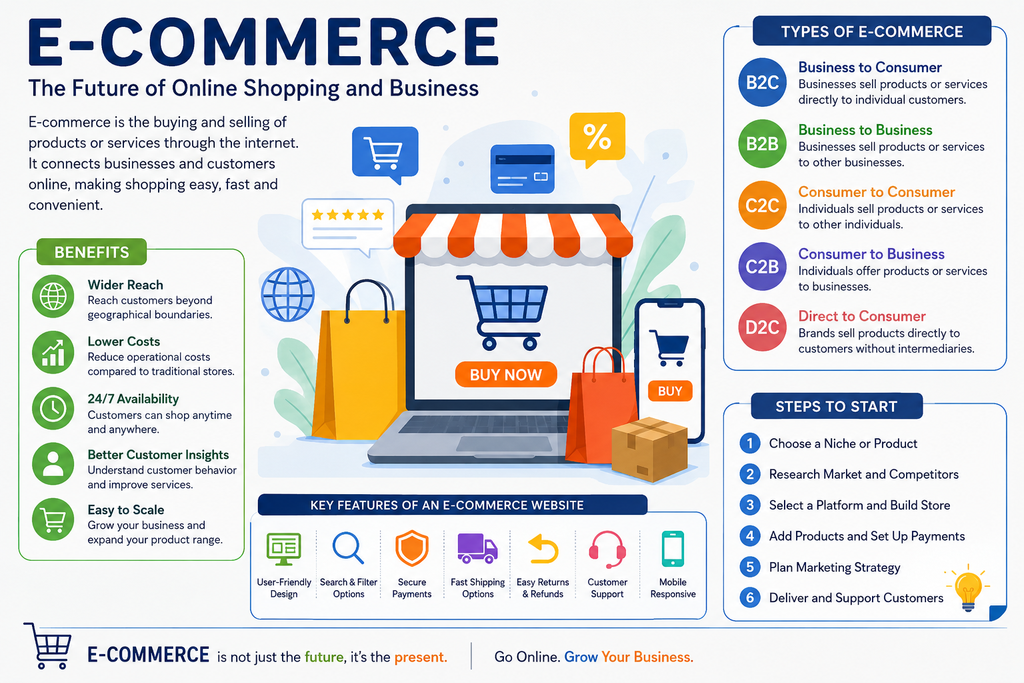
In today’s digital world, online shopping has become an important part of everyday life. Customers prefer buying clothes, electronics, beauty products, groceries, and many other items through websites and mobile applications. This change in shopping behaviour has created new opportunities for businesses to reach customers online.
E-Commerce marketing is the process of promoting products and services sold through online stores. It helps businesses attract visitors, increase product sales, build brand awareness, and develop long-term relationships with customers. Businesses use different digital channels, including search engines, social media, email, paid advertisements, and content marketing, to connect with their target audience.
For example, an online clothing store can use Google Ads to attract people searching for fashionable outfits, Instagram to showcase new collections, and email marketing to inform customers about discounts and special offers.
A successful online business needs more than just a website. It also requires a clear marketing strategy, attractive product pages, secure payment options, excellent customer service, and regular performance analysis.
This guide explains the meaning, importance, strategies, benefits, challenges, and future of online store promotion.
A well-planned E-Commerce marketing strategy helps businesses connect with potential buyers and improve their online presence.
What Is E-Commerce Marketing?
E-Commerce marketing refers to the strategies and techniques businesses use to promote their online stores and encourage customers to purchase products or services.
Its main purpose is to bring relevant visitors to an online store and convert them into paying customers. It also helps businesses maintain customer relationships after a purchase.
For instance, a business selling skincare products can publish helpful skincare blogs, optimise its website for search engines, run social media campaigns, and offer discounts to first-time buyers.
These activities help the business reach potential customers at different stages of their buying journey.
The main objectives include:
- Increasing website traffic.
- Improving brand awareness.
- Generating sales and leads.
- Increasing customer engagement.
- Improving conversion rates.
- Encouraging repeat purchases.
- Building customer trust and loyalty.
Businesses can choose different strategies depending on their products, budget, target audience, and marketing objectives.
Effective E-Commerce marketing combines customer research, online promotion, and performance tracking.
Why Is E-Commerce Marketing Important?
Online competition is increasing because customers can compare products, prices, reviews, and delivery options from multiple sellers within minutes. Businesses need effective promotional strategies to stand out from competitors.
1. Increases Online Visibility
Search engine optimisation, paid advertising, and social media promotion help businesses reach customers who may not know about their brand. Better visibility creates more opportunities to attract potential buyers.
2. Reaches the Right Audience
Digital platforms provide options for targeting people according to their interests, location, age groups, search behaviour, and shopping preferences, subject to platform policies.
For example, a business selling college bags can create campaigns for students and people interested in school or college accessories.
3. Generates More Sales
A well-designed campaign directs interested customers to relevant product pages. Clear descriptions, quality images, competitive prices, and convenient checkout options can encourage visitors to complete their purchases.
4. Provides Measurable Results
Businesses can track website visitors, advertisement clicks, conversions, revenue, and other performance indicators. This information helps marketers understand which campaigns are performing well.
5. Builds Customer Relationships
Email newsletters, loyalty programmes, helpful content, and responsive customer support can encourage customers to return for future purchases.
Consistent E-Commerce marketing can help businesses build trust and encourage repeat purchases.
Different Types of E-Commerce Marketing
Businesses can use several digital marketing methods to promote their online stores. Combining suitable channels often produces better results than depending on a single platform.
1. Search Engine Optimisation (SEO)
SEO improves a website’s visibility in unpaid search engine results. It helps potential customers discover products when they search for relevant information online.
For example, a shoe store may optimise its product pages for searches such as “women’s running shoes” or “comfortable sports shoes.”
Important SEO activities include:
- Conducting keyword research.
- Writing descriptive product titles.
- Creating useful product descriptions.
- Optimising images and alternative text.
- Improving website loading speed.
- Making the website mobile-friendly.
- Creating helpful blog content.
- Improving internal linking.
SEO generally requires consistent effort and may take time to produce meaningful results. However, it can help businesses attract relevant visitors without paying for every click.
SEO is an essential part of E-Commerce marketing because it helps customers discover relevant products through search engines.
2. Social Media Marketing
Social media platforms allow businesses to display products, communicate with customers, and build an online community.
Platforms such as Instagram, Facebook, Pinterest, and YouTube can support different promotional goals.
For example, a fashion store can publish outfit ideas, product demonstrations, customer reviews, styling videos, and festival collections.
Effective social media activities include regular posting, engaging captions, relevant hashtags, short-form videos, and timely replies to customer questions.
Businesses should select platforms based on where their potential customers spend time rather than trying to maintain every platform at once.
3. Pay-Per-Click Advertising (PPC)
PPC advertising allows businesses to display paid advertisements and pay according to the pricing model of the advertising platform.
Google Ads can help online stores reach people searching for specific products. Shopping campaigns can display product images, prices, and store information where eligible.
For example, an online electronics store may advertise headphones to users searching for wireless headphones.
To improve campaign performance, marketers should research keywords, organise campaigns properly, create relevant advertisements, set budgets, and monitor conversions.
Paid advertising can generate traffic quickly, but profitability depends on advertising costs, product margins, conversion rates, and average order value.
4. Email Marketing
Email marketing helps businesses communicate directly with customers who have agreed to receive their messages.
An online store can send product updates, new collection announcements, personalised recommendations, order-related information, and promotional offers.
Common email campaigns include:
- Welcome emails for new subscribers.
- Abandoned-cart reminders.
- Product recommendations.
- Seasonal sale announcements.
- Post-purchase follow-ups.
- Customer loyalty offers.
Messages should provide useful information and avoid excessive promotional emails. Businesses must also follow applicable privacy and marketing consent requirements.
5. Content Marketing
Content marketing involves creating useful and relevant material to attract and educate potential customers.
Examples include blog posts, buying guides, product comparisons, tutorials, videos, and frequently asked questions.
A beauty store might publish an article about choosing a moisturiser for dry skin. Readers who find the information useful may explore the store’s related products.
Useful content can build trust, answer customer questions, support SEO, and help people make informed purchasing decisions.
6. Influencer Marketing
Influencer marketing involves collaborating with content creators who have an audience relevant to a business.
For example, a clothing brand may work with a fashion creator to demonstrate how to style its products. A technology store may collaborate with a creator who reviews electronic devices.
Businesses should evaluate audience relevance, engagement quality, content style, and campaign costs before selecting a creator.
Sponsored partnerships should be disclosed clearly and honestly.
7. Affiliate Marketing
Affiliate marketing allows businesses to work with partners who promote their products through tracked links or codes.
When a qualifying purchase occurs, the affiliate may receive a commission according to the agreed terms.
This approach can help businesses reach new audiences while linking part of their marketing expenditure to measurable sales.
Clear commission rules, reliable tracking, and transparent promotional practices are important for successful affiliate programmes.
How to Create an Effective E-Commerce Marketing Strategy
A marketing strategy provides direction and helps businesses use their time and budget effectively.
Step 1: Identify Your Target Audience
Start by understanding the people most likely to purchase your products.
Consider their needs, interests, location, spending habits, problems, and preferred shopping platforms.
For example, a store selling affordable college accessories may focus on students who want useful products at reasonable prices.
Step 2: Set Clear Marketing Goals
Define what you want to achieve. Goals may include increasing website traffic, generating more orders, improving conversion rates, or encouraging repeat purchases.
Use measurable targets and realistic deadlines so that you can evaluate progress.
Step 3: Conduct Keyword Research
Find the words and phrases potential customers use when searching for products.
You can use tools such as Google Keyword Planner and Google Search Console to support keyword research and performance analysis.
Choose relevant keywords for product pages, category pages, and informational articles. Avoid repeating the same phrase unnaturally throughout the content.
Step 4: Optimise Your Website
Your online store should be easy to navigate and use on mobile devices.
Provide clear product categories, readable descriptions, high-quality images, transparent pricing, delivery information, and visible contact details.
A simple checkout process can reduce unnecessary obstacles that prevent customers from completing orders.
Step 5: Select the Right Marketing Channels
Choose channels that match your audience and goals.
SEO and content marketing can support long-term visibility, while paid advertising may help attract targeted traffic more quickly. Social media can support product discovery, and email marketing can help maintain customer relationships.
Begin with a manageable number of channels and expand when you understand the results.
Step 6: Create Valuable Content
Develop content that answers customer questions and demonstrates product benefits.
Use accurate descriptions, helpful images, comparison guides, and demonstrations. Explain how a product works and what makes it suitable for a particular need.
Avoid misleading claims and copied product descriptions.
Step 7: Track Performance
Use suitable analytics tools to monitor website traffic, advertising performance, orders, revenue, and customer behaviour.
Review the data regularly to identify successful campaigns and areas that need improvement.
Step 8: Test and Improve
Test different headlines, images, offers, landing pages, and calls to action where appropriate.
Compare results over a meaningful period and make changes based on evidence rather than assumptions.
Best Tools for E-Commerce Marketing
Marketing tools can simplify research, campaign management, website optimisation, and performance measurement.
Google Analytics 4: Helps analyse website traffic, user interactions, and conversions when tracking is configured correctly.
Google Search Console: Provides information about search visibility, search queries, indexing, and website search performance.
Google Ads: Supports paid advertising campaigns across Google’s eligible advertising placements.
Meta Business Suite: Helps manage Facebook and Instagram content, messages, and other business activities.
WordPress and WooCommerce: WordPress supports website publishing, while WooCommerce can add online shopping functionality to a WordPress website.
Canva: Helps create promotional graphics, social media posts, banners, and other visual content.
Mailchimp: Provides email marketing and automation features, depending on the selected plan.
The right tools depend on business size, budget, technical requirements, and marketing objectives. Businesses should review pricing, available features, and privacy requirements before choosing a tool.
Benefits of E-Commerce Marketing
Online store promotion offers several advantages when supported by a suitable strategy.
Wider Customer Reach
Businesses can connect with customers beyond their immediate geographical area. Depending on delivery arrangements, products may reach customers across different cities or countries.
Cost Flexibility
Businesses can begin with organic content, SEO, and small advertising budgets. Spending can increase when campaigns demonstrate satisfactory performance.
Personalised Communication
Customer preferences and previous interactions can help businesses provide more relevant recommendations and messages, provided data is collected and used appropriately.
Better Performance Measurement
Digital campaigns provide measurable information that helps businesses evaluate traffic, engagement, conversions, and costs.
Improved Customer Retention
Follow-up messages, loyalty benefits, helpful support, and relevant recommendations can encourage repeat purchases.
Business Growth Opportunities
Businesses can test new products, reach additional customer groups, and expand into new markets without immediately opening physical stores in every location.
Common E-Commerce Marketing Challenges
Although digital promotion offers many opportunities, businesses may face several challenges.
High Competition
Many sellers promote similar products. Businesses need clear positioning, reliable service, useful content, and a strong customer experience to stand out.
Advertising Costs
Paid campaigns can become expensive when targeting is too broad or conversion rates are low. Regular performance reviews help identify unnecessary spending.
Building Customer Trust
Customers may hesitate to buy from an unfamiliar store. Genuine reviews, secure payment options, clear policies, accurate descriptions, and accessible support can help build confidence.
Cart Abandonment
Customers may leave before completing checkout because of unexpected delivery charges, complicated forms, limited payment options, or uncertainty about returns.
Businesses can improve checkout usability, display total costs clearly, and provide accurate delivery information.
Changing Customer Behaviour
Customer preferences and digital platforms change over time. Businesses need to review performance, listen to feedback, and update their strategies when necessary.
Measuring Profitability
High traffic or many clicks do not automatically mean a business is profitable. Marketers should consider product costs, shipping, returns, discounts, advertising expenditure, and other operating expenses.
Important Metrics to Measure Marketing Performance
Measuring performance helps businesses understand whether their marketing activities are delivering useful results.
Website traffic: The number of visits or users recorded by the website analytics system.
Click-through rate (CTR): The percentage of impressions that result in clicks.
Conversion rate: The percentage of relevant visitors or interactions that result in a desired action, depending on how it is defined.
Cost per acquisition (CPA): The cost of acquiring a customer or another specified conversion.
Average order value (AOV): The average amount customers spend per order.
Return on advertising spend (ROAS): The revenue attributed to advertising divided by advertising expenditure.
Customer retention rate: The proportion of customers who continue purchasing over a defined period, using a consistent measurement method.
For example, if a campaign generates ₹20,000 in attributed revenue from ₹5,000 in advertising expenditure, its ROAS is 4:1. This does not automatically mean the business made a profit because other costs must also be considered.
Future Trends in E-Commerce Marketing
Online shopping and digital promotion continue to evolve as technology and customer expectations change.
Artificial Intelligence
AI tools can help marketers generate content ideas, analyse data, assist with customer support, and develop product recommendations. Human review remains important for accuracy, originality, and brand consistency.
Personalised Shopping Experiences
Businesses increasingly use relevant product recommendations, tailored messages, and customer preferences to improve shopping experiences while respecting privacy.
Video Commerce
Short videos, product demonstrations, livestreams, and creator content can help customers understand products before purchasing them.
Mobile Shopping
A large number of customers browse and shop through smartphones. Fast mobile pages, readable content, and easy checkout processes are therefore important.
Voice and Visual Search
Customers may discover products through spoken questions or image-based searches. Descriptive product information and well-optimised images can help support product discovery.
Omnichannel Marketing
Businesses are combining websites, social media, email, physical stores, and customer support to provide a more consistent shopping experience across channels.
Companies that test emerging methods carefully and focus on customer needs can adapt more effectively to changing market conditions.
Conclusion
E-Commerce marketing plays an important role in helping online businesses attract customers, promote products, generate sales, and build lasting relationships. A successful approach combines a user-friendly website with relevant content, SEO, social media, paid advertising, email communication, and reliable customer service.
Businesses should first understand their target audience, set measurable goals, select suitable marketing channels, and track important performance indicators. They should also focus on customer trust, transparent communication, and continuous improvement.
There is no single strategy that works equally well for every online store. The best results come from selecting methods that suit the business’s products, budget, audience, and long-term goals. With consistent effort and data-based decisions, businesses can improve their online presence and create better shopping experiences.
VISIT MY HOME PAGE
Frequently Asked Questions (FAQs)
1. What is E-Commerce marketing?
It is the process of promoting products and services sold through online stores using methods such as SEO, social media, email campaigns, content creation, and paid advertising.
2. Why is online store promotion important?
It helps businesses improve visibility, attract relevant visitors, generate sales, measure performance, and build relationships with customers.
3. Which marketing strategy is best for an online store?
The right strategy depends on the target audience, product category, budget, and business goals. SEO, social media, paid advertising, and email marketing can work together.
4. Is SEO useful for online stores?
Yes. SEO can help product and category pages appear in relevant unpaid search results and attract potential customers who are actively searching for products.
5. How can a business measure marketing success?
Businesses can track website traffic, conversion rates, acquisition costs, average order value, customer retention, revenue, and advertising returns.
6. Can small businesses promote products with a limited budget?
Yes. Small businesses can start with useful organic content, basic SEO, social media activity, and carefully planned campaigns before increasing their budgets.
7. What is the difference between SEO and PPC?
SEO focuses on improving unpaid search visibility, while PPC uses paid advertising models. SEO may take longer to show results, whereas paid campaigns can generate traffic while advertisements are running.
8. How does social media help online stores?
Social media helps businesses showcase products, share useful information, engage with potential customers, and direct interested users to their online stores.
9. What is the role of email marketing?
Email marketing helps businesses share updates, communicate offers, recommend relevant products, and maintain relationships with customers who have subscribed.
10. What is the future of online store promotion?
Important developments include AI-assisted marketing, personalised shopping, video commerce, mobile-first experiences, and integrated customer journeys across multiple channels.