Welcome to Neha Marketing. Digital marketing helps businesses reach their target audience, improve their online presence, and attract potential customers. Through SEO, social media marketing, content marketing, and online advertising, businesses can work towards their marketing goals.
On this page, we explain how a digital marketing strategy can be planned and evaluated using a sample business case study.
What Is a Digital Marketing Case Study?
A digital marketing case study explains a marketing challenge, the strategy used to address it, the activities performed, and the results measured. It helps readers understand how different digital marketing techniques can be applied to real business situations.
A case study may include website traffic, keyword rankings, engagement, leads, conversions, and advertising performance.
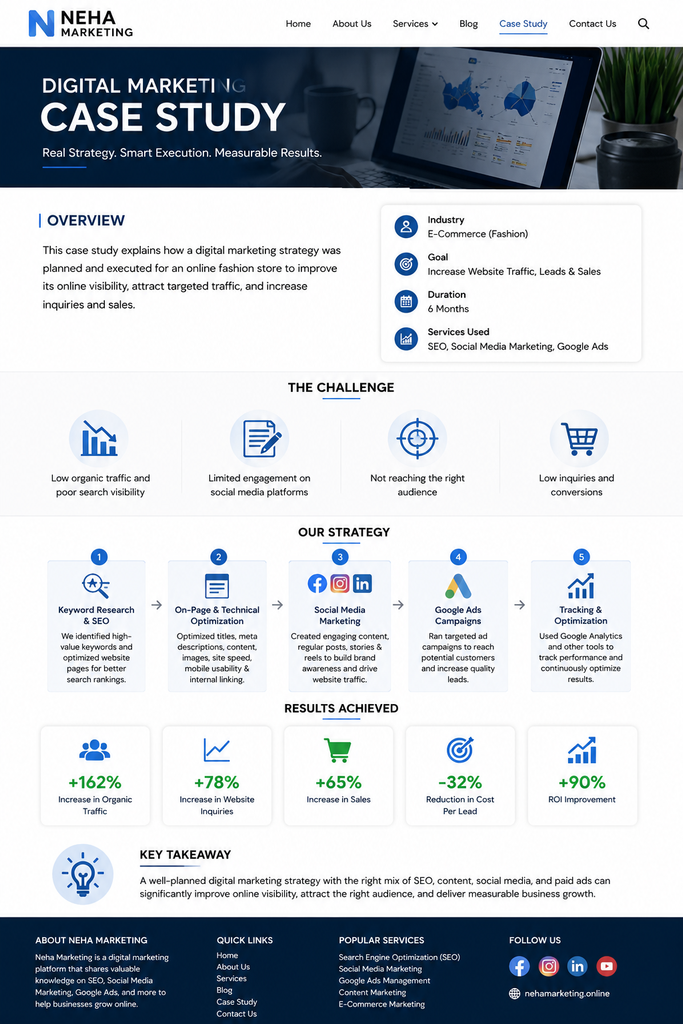
Digital Marketing Case Study: Improving an Online Store’s Visibility
Note: This is an illustrative example created for learning purposes, not a verified client project.
1. Business Overview
Imagine an online store that sells clothing and fashion accessories. The business has a website but receives limited organic traffic and few inquiries from potential customers.
The business wants to improve its search engine visibility, reach relevant audiences, and increase product visits.
2. Main Challenges
The sample business faces the following challenges:
- Low organic traffic to product pages.
- Product descriptions that provide limited information.
- Poor targeting of relevant search keywords.
- Limited activity on social media platforms.
- No clear system for measuring conversions.
3. Marketing Goals
The business sets the following goals:
- Improve website visibility in search engines.
- Reach people interested in its products.
- Improve product page engagement.
- Attract more qualified visitors.
- Measure inquiries and purchases accurately.
4. SEO Strategy
Search engine optimization (SEO) is used to improve the website’s visibility in organic search results.
The planned activities include:
- Researching relevant product keywords.
- Writing useful and original product descriptions.
- Optimizing page titles and meta descriptions.
- Improving internal links between related pages.
- Checking mobile usability and website loading speed.
- Reviewing indexing and technical issues in Google Search Console.
5. Social Media Marketing Strategy
Social media platforms can help the store introduce its products to a relevant audience.
The planned activities include publishing product photos, creating short videos, sharing useful styling tips, and answering customer questions. Content performance is reviewed through reach, engagement, profile visits, and website clicks.
6. Paid Advertising Strategy
The business may test Google Ads to reach users searching for relevant products. Social media advertising can also be tested to introduce products to suitable audiences.
Before increasing the advertising budget, the business should review clicks, cost per click, conversions, and return on ad spend. Campaign performance must be measured rather than assumed.
7. Measurement and Analysis
The business uses Google Analytics and Google Search Console to monitor website performance.
Important measurements include:
- Organic search clicks and impressions.
- Website visitors and traffic sources.
- Product page views.
- Add-to-cart activity.
- Completed purchases and conversion rate.
- Advertising costs and revenue attributed to campaigns.
These measurements help identify which strategies are working and where improvements are needed.
8. Expected Learning and Improvements
By following this strategy, the business can identify relevant keywords, improve product pages, understand audience behaviour, and make more informed marketing decisions.
Actual outcomes depend on competition, product quality, website experience, budget, and campaign execution. Results should be documented using real analytics data.
Key Takeaways
This sample case study demonstrates the importance of setting clear goals, choosing suitable digital marketing channels, tracking performance, and making improvements based on data.
A successful marketing strategy is not only about attracting visitors. It is also about reaching the right audience and helping visitors take meaningful actions.
Conclusion for Digital Marketing Case Study
Digital marketing case studies help students, marketers, and business owners understand how marketing strategies can be planned and evaluated. SEO, social media marketing, and paid advertising can support business growth when they are used strategically and measured consistently.
At Neha Marketing, our aim is to share helpful information about digital marketing, SEO, Google Ads, social media marketing, and e-commerce marketing to support continued learning.
Neha Marketing — Learn, Grow, and Succeed in Digital Marketing.
VISIT – HOMEPAGE